Mesothelioma Prognosis

The Trusted Guide Survivors and Families Wish They’d Had After Diagnosis:
- What Your Diagnosis Means
- Advice from 101 Cancer Caregivers
- Treatment Options Explained
- What Survivors Did Differently
Answer 3 quick questions and we’ll ship your free Mesothelioma Kit today:
Answer 3 quick questions and we’ll ship your free Mesothelioma Kit today:
Thank You!

We will send you your free guide shortly.
 Your information will be kept private
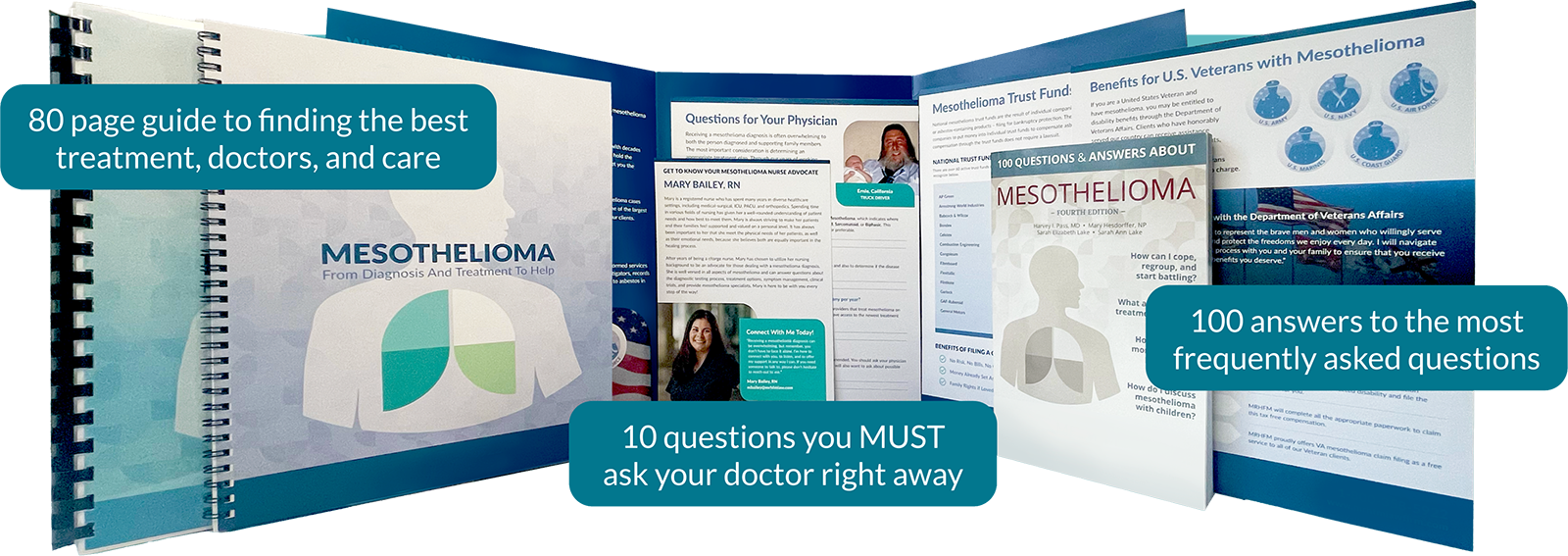
Your FREE Mesothelioma Care Kit Includes:
- 80-page guide to finding the best treatment, doctors, and care
- 100 answers to the most frequently asked questions
- 10 questions you MUST ask your doctor right away
- Best-selling cookbook: Cancer-Fighting Kitchen:
$32.50 - Award-winning book: Things I Wish I’d Known:
$19.95

The kit we received on mesothelioma is excellent and very well put together. We knew nothing about mesothelioma and this was the greatest resource we could get.

Hubert,
Pleural Mesothelioma
Patient in Massachusetts

Our Mesothelioma Care Kit provides the latest information on top treatment options and ways others have improved life expectancy.
What Is the Life Expectancy of a Person With Mesothelioma?
On average, a mesothelioma patient has a life expectancy between 12 to 21 months. But, as treatments continue to evolve, it’s possible to live much longer.
There are three important factors which can impact life expectancy of a mesothelioma patient: location, cell type and stage.
Location

Life expectancy is best for patients with peritoneal mesothelioma (located in the abdomen), with those having surgery lasting an average of five years or more. Life expectancy for patients with pleural mesothelioma (located in the lungs) averages 3 years for those who have surgery. And life expectancy for pericardial mesothelioma (the heart), the most rare type, carries the poorest prognosis, with the median life span being 6 to 10 months.
Cell Type

The type of cells making up a patient’s mesothelioma determines how fast their disease will spread. Sarcomatoid cells, which are rare, typically spread the fastest. Epithelioid cells, which are most common, typically spread the slowest. Biphasic cells consist of sarcomatoid and epithelioid cells, which has a varying effect on a patient’s life expectancy.
Stage

Doctors use staging as a way of categorizing how advanced a patient’s mesothelioma is. The less advanced the mesothelioma, the better the life expectancy. Early stage mesothelioma has an average life expectancy of around 21 months while late stage averages closer to 12 months. With surgery and the right treatment options, some patients can push their life expectancies well beyond the averages.


Learn the numbers behind life expectancy estimates and find the best treatment options in your free Mesothelioma Care Package.
Mesothelioma Stage
By staging your disease, doctors can describe how far the mesothelioma has spread from where it originated. The farther the disease has spread, the more advanced it is and the later the stage. The earlier the stage, the more effective treatment options are available and the greater the life expectancy.
For pleural mesothelioma, doctors use stages 1-4, with stage 4 being the most advanced. Peritoneal mesothelioma does not have an accepted staging system so doctors diagnose these patients as having either localized or advanced stage mesothelioma.
Stages of Pleural Mesothelioma
- Stage 1: The cancer is localized to the point of origin.
- Stage 2: The cancer has spread to the lung itself, part of the diaphragm, and nearby lymph nodes.
- Stage 3: The cancer spread throughout one side of the chest, into the chest wall, esophagus and more lymph nodes.
- Stage 4: The cancer has spread into both sides of the chest, affecting other organs, the blood, and bone cells.
It’s important to note these statistics are based on the average lifespan of mesothelioma patients and includes averages for patients who didn’t receive treatment from a mesothelioma specialist. So, with the right treatment and situation, a patient could dramatically increase their life expectancy. According to the American Cancer Society, some life expectancies based on mesothelioma stage are:
Life Expectancy by Stage
- Patients with stage 1 or 2 pleural mesothelioma have an average life expectancy of 19 to 21 months.
- Patients with stage 3 or 4 pleural mesothelioma have an average life expectancy of up to 16 months.
- Patients with peritoneal mesothelioma who receive surgical treatment often have life expectancies greater than 5 years.


Our Mesothelioma Care Package provides additional information on how treatments affect your prognosis and life expectancy.
Cell Type and its Effect on Life Expectancy
Epithelioid cells are egg-shaped and stick to each other as they spread. As a result, they spread slowly, making epithelioid mesothelioma typically the most treatable cell type with the best prognosis. The average life expectancy of a patient with epithelioid mesothelioma ranges from 12 to 27 months, with some patients significantly outliving their prognosis. Incorporating palliative treatments can ease the symptoms and improve the quality of life for patients.
Sarcomatoid cells are spindle-shaped and spread quickly to other parts of the body — their speed makes them less responsive to treatment. The average life expectancy of a patient with sarcomatoid mesothelioma ranges from 7 to 18 months. It’s important to remember to never give up hope, no matter what the mesothelioma cell type diagnosis as many patients have outlived their initial prognosis.
Biphasic Tumors are made up of both epithelioid and sarcomatoid cells. The ratio of the two cell types determines the effect a biphasic mesothelioma tumor will have on your life expectancy. More epithelioid cells result in a longer life expectancy because epithelioid cells spread slowly and respond better to treatment. The average life expectancy of a patient with biphasic mesothelioma ranges from 8 to 21 months.
Mesothelioma Location
The location of mesothelioma — where it originates — also has an effect on life expectancy. Knowing if it’s in the lining of the lungs, abdomen, or heart determines available treatment options.

Pleural mesothelioma, originating in the lining of the lungs, the pleura, carries an average life expectancy range from 4 to 18 months. Because it accounts for 75 percent of all diagnosed cases, doctors have more experience treating pleural mesothelioma and therefore can offer more life-extending treatment options for you.

Peritoneal mesothelioma originates in the lining of the abdomen, the peritoneum, and typically has the best life expectancy. The average life expectancy for patients diagnosed with peritoneal mesothelioma is 12 months, though several studies have shown that having cytoreduction with HIPEC has extended the average life expectancy of some patients to 5 years and beyond.

Pericardial mesothelioma originates in the protective lining of the heart, the pericardium. It’s rare, accounting for about 1 percent of all diagnoses. The life expectancy for patients with pericardial mesothelioma is 6 months. Pericardial mesothelioma has limited treatment options because its rarity has given doctors few opportunities to develop new treatments.


More info on how cell types and location affect your prognosis in our free Mesothelioma Care Package.
Life-Extending Treatment
Surgery
Surgery an effective way to extend life expectancy. Mesothelioma patients have surgical options for both pleural and peritoneal mesothelioma. Even if your doctor says you aren’t eligible for surgical treatment, it’s highly recommended to get a second opinion from a mesothelioma specialist to confirm your treatment options.
There are two surgeries for patients with pleural mesothelioma: the extrapleural pneumonectomy (EPP) and the pleurectomy with decortication (P/D). One study reported that treatment with the EPP increased the overall survival rate of patients to about 27.5 months. The (P/D) —a less invasive procedure for patients with pleural mesothelioma — has produced results similar to the EPP, extending the survival rate of pleural mesothelioma patients to about 20 months. Both having patients who have significantly outlived their prognosis and life expectancy.
Cytoreductive surgery with heated intraperitoneal chemotherapy (HIPEC) is the most effective surgical option for peritoneal mesothelioma. There are reports of patients increasing their life expectancy to greater than 7 years with this treatment.
Multimodal Therapy
Combining two or more treatment options including surgery, chemotherapy, and radiation therapy, multimodal therapy is proven to improve the life expectancy of patients with mesothelioma regardless of location.
According to a few recent studies, pleural mesothelioma patients who had an EPP combined with chemotherapy and radiation therapy experienced a median survival rate ranging from 13 to 23.9 months. Those who had a multimodal therapy combining P/D with chemotherapy and radiation therapy resulted in an even better survival rate of 30 months with some patients significantly beating their initial prognosis.
Cytoreduction with HIPEC is also a form of multimodal treatment. It’s a combination of surgery to remove tumors in the abdomen and heated chemotherapy applied directly to the abdominal cavity, which kills microscopic cancer cells after the procedure.
Emerging Treatments
Developed and tested in clinical trials by medical researchers, emerging treatments find better ways to treat patients. Stage-three or stage-four mesothelioma patients that may not qualify for traditional treatments, like the EPP or a P/D, may benefit from emerging treatments including immunotherapy, gene therapy and photodynamic therapy.
Discover how other patients have improved their prognosis